
It started with a simple question: How can we respond effectively to large-scale threats against critical infrastructure, civilian lives, and our defense forces?
The expertise required to solve these challenges already exists - but it is decentralized. It is distributed across technology companies, research teams, system designers, manufacturers, suppliers, mission experts, and domestic industrial partners. Each contributes valuable capabilities, yet these capabilities often remain isolated from one another.
Meridron brings this distributed know-how together within a Joint Venture framework.
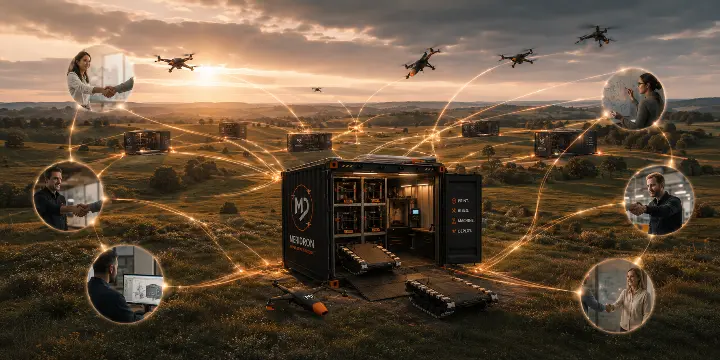 Contributors provide intellectual property, designs, technologies, and specialized R&D expertise. Suppliers contribute components and supply-chain capabilities. Domestic Partners provide local production capacity, market access, installation, and customer proximity. Meridron connects these capabilities, industrializes the solutions, manages the production and supply-chain framework, and integrates them into a scalable portfolio.
The objective is not to centralize all knowledge within a single organization. It is to connect decentralized expertise and make it operationally effective - turning individual capabilities into an integrated ecosystem for production, supply, deployment, and mission execution.
This creates a flexible platform where existing solutions can be combined, adapted, made ready for mass production, and deployed where they are needed.
The Lesson from Ukraine
The answer requires more than a new product. It requires a fundamentally different approach to how defense systems are developed, produced, supplied, and deployed.
Ukraine demonstrates why. Drones are not built exclusively in large, centralized factories. Small workshops, garages, and even private households contribute to decentralized production - for good reason. A successful strike against a central facility can eliminate a significant share of production capacity at once.
Decentralized production distributes this risk.
Decentralized Production Is the Key
This insight shaped Meridron’s vision: capabilities must be distributed physically while remaining connected organizationally.
The goal is to connect knowledge, integrate existing solutions, and create a shared ecosystem that brings together production, supply chain, systems, and operational capabilities.
Our guiding principle
Production and Supply Chain First. Mission and Effectors on Top.
Even the most advanced design can only fulfil its purpose if it can be manufactured reliably, affordably, and at the required scale. Production capability and material availability are therefore not secondary considerations. They are the foundation.
Scaling Through Connected Factory Cells
The Meridron concept is based on decentralized, semi-automated Factory Cells. These mobile or stationary production units can be deployed wherever additional capacity is needed.

Our target: One Factory Cell can produce up to 40 UAVs per day. Connect a second Cell, and capacity increases to as many as 80 units. Add a third, a fourth, and more - the total output continues to scale.
The individual Cells can operate at different locations. Together, they form a virtual production grid that provides capacity dynamically while increasing the resilience of the entire system.
If one out of 100 production units is destroyed, the other 99 continue operating.
This is resilience not as an additional feature, but as a core design principle.
More Output, Fewer Dependencies
Decentralization does more than increase resilience. Domestic production also reduces dependencies on international supply chains, centralized manufacturing facilities, and export restrictions.
The Factory Cells are designed for a high degree of automation and minimal personnel requirements. The target is for two trained operators to run a Cell without requiring extensive previous experience in industrial manufacturing.
This reduces entry barriers, accelerates the establishment of additional capacity, and enables rapid scaling across multiple locations.
One Cell, One Complete Portfolio
Each Factory Cell is designed to manufacture the entire integrated portfolio without conventional retooling between different product types.
The output is not limited to UAVs. The production grid can provide:
- UAVs for different mission profiles
- UGVs for ground-based applications
- Spare parts and consumable components
- Tools and operational equipment
- Other designs adapted for mass production
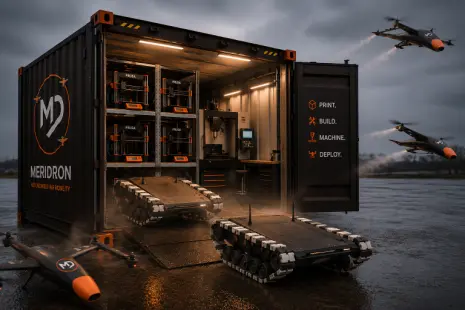 This creates more than a drone factory. It establishes a versatile production infrastructure that can dynamically adapt its output to operational demand and mission requirements.
Applications such as CUAV Drone Walls and strike missions depend on systems being available at scale. The production grid provides the industrial foundation required to deliver that mass.
Open to Existing and New Designs
Meridron does not focus solely on its own systems. Third-party designs can also be adapted for scalable manufacturing and integrated into the portfolio.
A proven solution does not need to be reinvented. What matters is making it ready for mass production: reproducible, material-efficient, supply-chain-ready, and capable of being manufactured at consistent quality across multiple Factory Cells.
This transforms individual solutions into a growing ecosystem. Contributors provide designs, technologies, and specialized know-how. Meridron combines these capabilities with industrialization methods, a dynamic supply chain, and decentralized scalability.
More Than Production
Providing systems alone is not enough. Technology only delivers value when people can operate it safely and effectively.
Training for operation and mission execution therefore complements the Meridron concept. Our objective is to create an integrated portfolio for air and ground applications, supported by the necessary production, supply-chain, and training infrastructure.
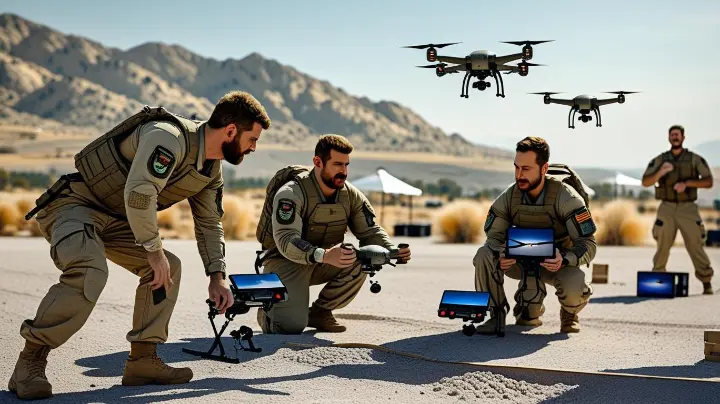
This is what we are building: a resilient, scalable, and connected ecosystem that makes capabilities available where and when they are needed.
Become Part of the Ecosystem
Do you have expertise that could strengthen the ecosystem? A design that requires significantly greater production output? Or insights into demands and missions that still lack a scalable solution?
Let us connect capabilities, industrialize solutions, and build the next generation of resilient production together.