
No Brick in the Wall: Rethinking Counter-UAS and Missile Defence
Counter-UAS is no longer a niche requirement. It is becoming an existential challenge for critical infrastructure, military bases, naval vessels and entire urban areas.
Low-cost attack drones and loitering munitions can now be deployed at scale, overwhelming air-defence systems designed for smaller numbers of expensive, high-value targets. At the same time, the growing use of ballistic missiles against civilian areas exposes another structural weakness: conventional interceptor-based defence is becoming economically unsustainable.
When Defence Costs More Than the Threat
Today, defeating a single inexpensive attack drone may require two or even three sophisticated interceptors to achieve an acceptable probability of success.
This creates a fundamentally unfavourable cost-to-kill ratio. A relatively simple threat costing tens of thousands—or sometimes only thousands—can trigger a defensive response worth hundreds of thousands or even millions.
The attacker controls the tempo. The defender carries the cost.
Complex interceptors must detect, track, predict and continuously correct their trajectories against fast-moving targets in an increasingly dynamic and congested battlespace. Every additional incoming object increases the burden on sensors, command systems, launch platforms and available ammunition.
More expensive interceptors alone will not solve a problem driven by mass.
Stop Chasing the Threat. Block Its Path.
Meridron’s Drone Wall solution approaches the challenge from a different direction.
Instead of assigning one sophisticated interceptor to chase each incoming target, large numbers of affordable FPV drones form adaptive defensive barriers across anticipated attack corridors.
The principle is simple: every drone, loitering munition or missile approaching a protected area must pass through the wall.
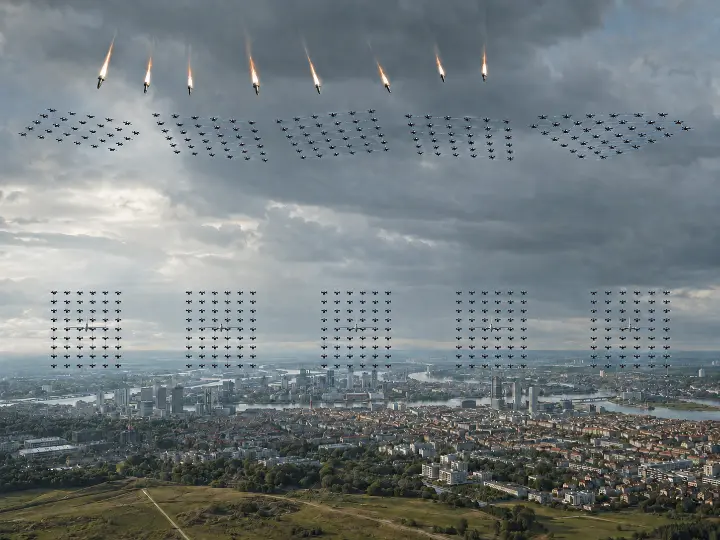
Stored in compact container-based launch and standby systems, the drones remain protected and ready until required. Once activated, they deploy rapidly and connect as a coordinated swarm. Multiple formations can create layered defensive walls at different positions, altitudes and angles.
These walls continuously adapt to the evolving threat picture. Individual drones reposition themselves, close emerging gaps and maintain the integrity of the interception zone. When an incoming threat reaches the defined proximity envelope, the nearest available drone engages and neutralizes it.
The result is an intelligent, airborne minefield - dynamic rather than static, deployable rather than permanently installed, and capable of reshaping itself in real time.
Mass Against Mass
A Drone Wall does not depend on a small inventory of highly complex interceptors. It is built around affordable drones that can be produced rapidly, deployed in large numbers and replaced without waiting for long production cycles.
Its strength comes from scalability:
- Mass-producible FPV platforms
- Distributed and containerized deployment
- Coordinated swarm behaviour
- Adaptive, layered formations
- Rapid replacement of expended units
- A cost structure aligned with the incoming threat
This changes the economics of air defence. Instead of answering low-cost mass attacks with scarce high-end ammunition, defenders can deploy a reproducible system designed for volume from the outset.
High-end air-defence systems would remain essential against selected threats. Drone Walls add another layer: a scalable defensive barrier that preserves expensive interceptors for the targets that truly require them.
One Architecture, Multiple Protection Scenarios
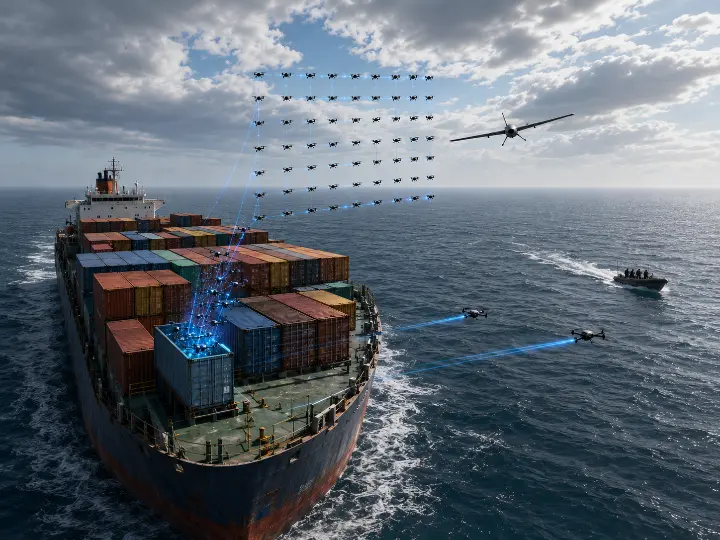
The same modular concept can protect a wide range of assets and operational environments:
- Critical infrastructure and energy facilities
- Urban areas and civilian population centres
- Military bases and forward operating locations
- Ports, logistics hubs and industrial sites
- Cargo vessels and naval formations
- Temporary humanitarian or emergency-response zones
The architecture also has potential beyond aerial defence. Individual drones or coordinated elements could be redirected against hostile ground assets, creating a platform that supports both defensive interception and selected strike missions.
Built for Distributed Readiness
For Meridron, the Drone Wall is not only a formation in the sky. It is part of a wider ecosystem combining distributed production, containerized deployment, resilient command and control, and scalable autonomous coordination.
The required drones do not need to be rare or exquisite. They need to be available, connected and deployable in sufficient numbers - where and when they are needed.
Future defence will not be defined solely by the sophistication of an individual interceptor. It will be defined by the ability to manufacture, deploy, coordinate and replenish capability at scale.
The answer to mass is mass - but intelligent, adaptive and affordable.
Build the Wall Before the Threat Arrives
Meridron is developing scalable drone ecosystems designed for distributed production, rapid deployment and mission-specific integration.
We are looking for industrial partners, technology providers, defence organizations, infrastructure operators and investors ready to explore the next generation of layered protection.
Let’s build a defence architecture that can scale as fast as the threat.
Contact Meridron to discuss partnerships, demonstrations and deployment scenarios.
